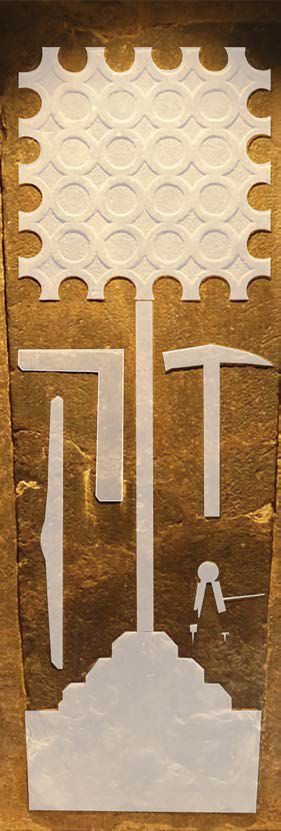
In the heart of the Abbey of Bon-Repos sleeps a fascinating architectural secret. A humble tombstone, decorated with a compass d This enigmatic instrument, far from being a mere decorative tool, is a key to understanding the geometrical prowess that shaped our most beautiful monuments.
The transmission of this ancestral knowledge is now a valuable legacy. Recent research shows that less than 5% of the specific tools used by medieval builders have been correctly identified and understood by contemporary historians.
How to decipher the visual code of fellow builders through the centuries
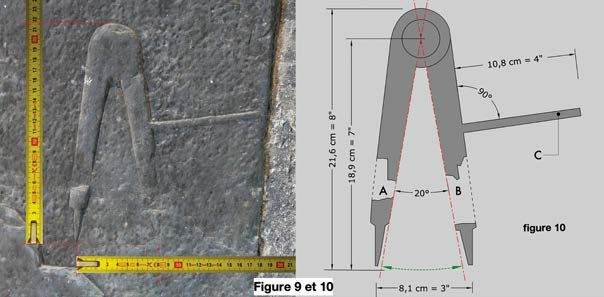
The compass engraved on the stone has singular characteristics that intrigue immediately the informed eye. Its right arm extended to 90° and its robust bill do not match the usual representations of this instrument. This particularity is not a design defect, but a deliberate sophistication.
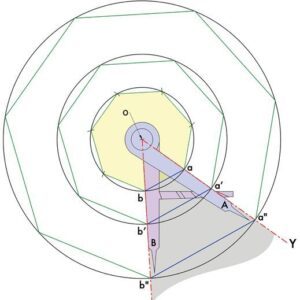
Indeed, this ingenious instrument allowed medieval artisans and artisans to trace with remarkable precision all the regular polygons, fundamental elements of sacred architecture. The method, an elegant simplicity, was to strategically position the branches of the compass to automatically determine the key points of the perfect geometric figures.
The visual presentation itself is a coded message. The specific opening angle of the compass – about 20° – allowed initiates to immediately identify its particular function. Conversely, a closed representation would have made its identification much more difficult for the non-initiated.
The dimensions of this compass, corresponding precisely to the king's foot of 1668, also establish a fascinating metrological link with the Tree of Jesse, ornamental jewel of the Abbey. This correspondence strongly suggests its use in the design of the complex plant motifs that characterize this remarkable work.
Why these old tools demonstrate exceptional practical intelligence
The eloquence of simplicity deeply characterizes the companion approach. This humble compass, by its very conception, directly incorporated the geometric knowledge necessary for construction. Thus, the young itinerants of the Tour de France did not need to memorize complex formulas – the tool itself contained knowledge.
Moreover, This discovery is part of a remarkable historical continuity with other architectural design instruments, such as the famous 13th century Hugues Libergier compass. Throughout the ages, Companions and Companions have always preferred personalized tools that directly integrate their expertise.
The precise handling of this compass to make regular polygons reveals a universal method of rare elegance. First, the craftsman linked the intrados of the mobile branch to the marker corresponding to the desired polygon. Then the centre of the circumference was naturally determined by the intersection of branch extensions. This pragmatic approach perfectly characterizes the companion spirit.
Readers of our latest review The Companion will discover the complete and detailed analysis of this extraordinary witness of our architectural heritage, with explanatory diagrams and in-depth historical context.
What other secrets can these humble tools carved in the stone reveal to us on the methods and ingenuity of the builders who shaped our heritage?