Companion Traditions pass through the centuries through oral but also written transmission. Our latest issue of Le Compagnonnage immerse you in the fascinating history of Le Devoir's wood turning companions, whose first written regulations date back to 1731. This corporation, among the oldest of the Companionage, offers us an exceptional testimony on the evolution of practices and symbols throughout nearly three centuries.
How a simple rule book reveals the soul of the Companion once
The small book of the rules of the Nice Touring Companions of the Devoir de Bordeaux is an invaluable treasure to understand the Companion under the Ancien Régime. Indeed, this document dated 1731 takes us to a world where the Christian faith rhythmized every aspect of companion life.
« Today 9 of the month of April 1731, we all Companions Tourners of Bordeaux found about having a Mass say at the feast of Saint Michael, all annual holidays, our Lady's Day and First Sunday of each month », can we read in this valuable document.
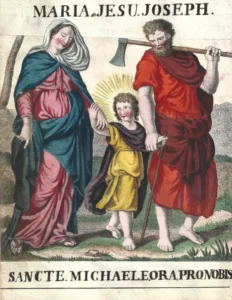
This text also reveals the hierarchical organization of the Turner Companions with the mention of the Captain, the roler and other essential functions. In addition, the document contains three rare images depicting Saint Michael (the patron saint of the turners), the holy family and the baptism of Christ – symbolic choices that had profound meaning in their initiatory rituals.
Note also that these Companions, often illiterate, drew their symbolic references from the ubiquitous Christian imagery in their daily lives: stained glass windows of cathedrals, religious sculptures and biblical accounts formed the basis of their spiritual and professional culture.
Why the rediscovery of this document in 2025 transforms our understanding of the Companion
The story of this little book is almost as fascinating as its content. After serving with the Touring Companions of Bordeaux and then Marseilles, he was entrusted in the middle of the 19th century to the Companion Pierre Audebaud, Saintonge la Fidelité, established as a chaisier and tourner at Saint-Maximin near the Sainte-Baume.
From father to son, this precious document was preserved until the early 20th century. Thus, Louis-Octave Audebaud, son of Pierre and also Compagnon tourner received in 1887 under the name Provençal la Fidelité, kept these archives until his death in 1922.
In 1889, when the company of wood-turners had only three active cities (Paris, Lyon and Marseille), This document was already evidence of a past era. Later, he passed into various hands, including those of historian Émile Coornaert, who partially published its contents in his reference work on the Companion in 1966.
Long regarded as lost after the death of Coornaert in 1980, this little book was finally rediscovered in 2025 by an attentive stained glass companion from a Parisian bookmaker.
This providential rediscovery allows us today to better understand the spiritual evolution of the Companion, From its deeply Christian roots to its progressive adaptation to the social and cultural transformations of the 19th and 20th centuries.
How does this unique document help us to understand the initiatory practices of Companions in the past? Discover the complete analysis and secrets of this book in our latest review.
https://www.lepagnonning.com/magazines/