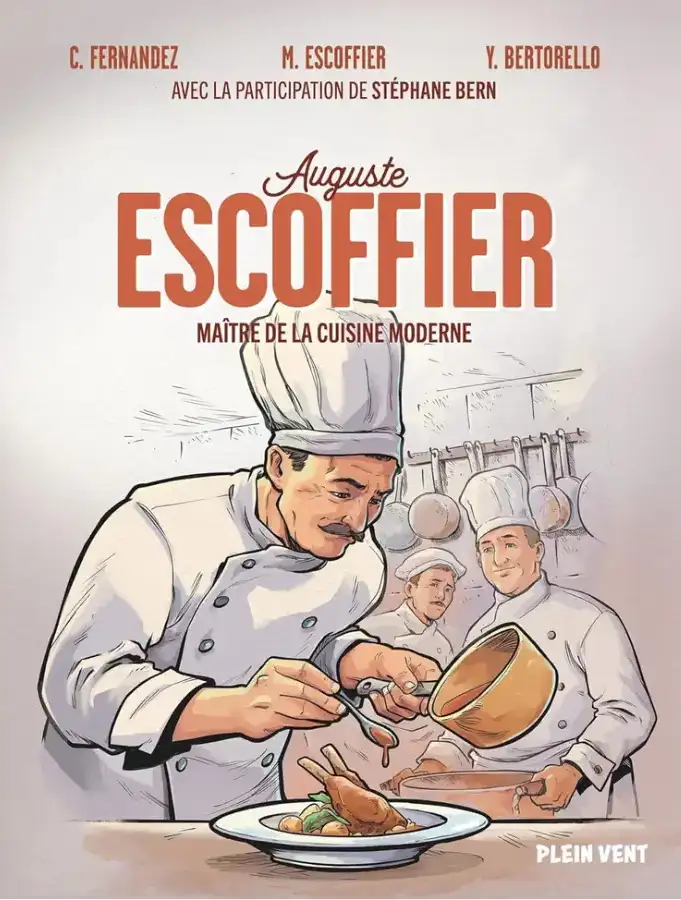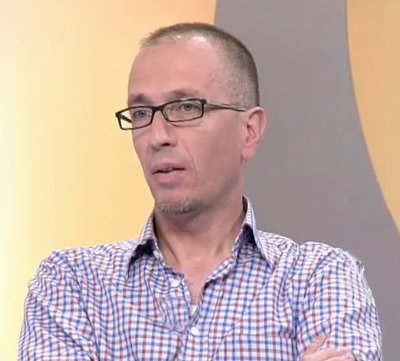

On the occasion of the release of the comic book dedicated to Auguste Escoffier, released last May, to the editions Plein Vent the magazine Le Compagnonnage offers you to discover the interview with Yvon Bertorello, writer and author of historical accounts.
The Companion. How did you become a comic book writer?
I worked as a freelancer for about 20 years as a director and co-author of reports and documentaries in France and abroad. I also published works by Albin Michel, sometimes under pseudonym.
One day, I submit a manuscript to my publisher who advises me to present my story as the scenario of a comic strip. I didn't know anything about comics, but I took advantage of the book fair in Paris to meet publishers, especially Glénat, whom I recalled shortly afterwards. I'm going a little bit to pitch my story that seduces my interlocutor, Laurent Muller. A month later, my first comic book scenario is validated: Codex Sinaiticus which will be published in 2008 and available in three volumes.
I always leave from a real fact, in this case, the quest for the oldest known manuscript of the Old Testament which was discovered and captured by an adventurer and archaeologist a little illuminated, Konstantin von Tischendorf. 40% of the story corresponds to historical facts but the rest of the story is invented.
After this success, I continued to shoot documentaries in mystical and sometimes mysterious places with my co-author Eddy Vicken, like Mount Athos, a high place of Christianity in northern Greece or at the contemporary abbey and « Romance » Barroux in Haute Provence, with a voice off of Michael LonsdaleThen I ended up focusing on the comic book.
How to reconcile the requirement of the narrative with the desire not to deflower the historical reality?
When you write, either you produce fiction or you devote yourself to history. With my co-sponsors, we do both a little. There are also cases where strictly historical narratives are discussed, but I tend to avoid chronological narratives, without any point of view. For example, I can have a dialogue of historical characters with the contemporary era in order to cross perspectives rather than confine myself to a linear and a little academic narrative. However, when I evoke the past, I respect historical reality: dates, places, uniforms... I'm trying to reconcile the playful dimension with the historical seriousness.
Does your work with cartoonists on historical and/or religious subjects have an educational vocation?
I don't have a taboo subject. If anyone asks me to devote myself to characters like Stalin ou MussoliniThis may seem extreme but I do not forbid myself. I'm trying to be objective. With my co-authors, we have worked on religious personalities, historical figures, but also exemplary beings such as the Righteous among nations, resistors, men and women who do good.
My motivation is transmission. History is less interesting to people, so today we need to find other vectors to transmit memory, heritage, values, our culture.
With comics, we touch all social strata. Workers, peasants, the poor, but also former ministers, for example, are passionate about comics.
Why did you write about Auguste Escoffier?
First of all, I want to clarify that this is a collective work. I had the chance to work with the writer and cartoonist Cédric Fernandez, Michel Escoffier, great-grandsonAuguste, without forgetting the support of Stéphane Bern and the preface of the Prince Albert II of Monaco who is himself a disciple ofEscoffier.
Auguste Escoffier is the embodiment of incomparable know-how, of a vision of his profession, but also of values that transcend us. Before becoming the famous master of what would become modern French gastronomy, it must be remembered that he was born into a modest, very hardworking and pious family. It happens that in our culture, food occupies an important place: the alliance of bread and wine is both a ritual of sharing and a biblical sacrament. Escoffier was imbued with the values of Christianity that guided him in his concern for the kitchen workers: he did not bear injustice and social misery, and cared for the condition of young cooks.
Having lived many years in England, Escoffier concluded an agreement with the Little Sisters of the Poor so that the needy could be better fed. Escoffier However, he did not only give the remains to the poor, he ordered a larger volume of food to redistribute part of it to the poor, and he fought against wastage. Thus, when he was in England in charge of the kitchens of luxury establishments such as Savoy or Carlton, the dishes prepared for the rich were also intended for the poor who enjoyed the famous quails mentioned in his memoirs.
What do you know about the Companion?
I come from a family of laborious, Pemontese and Dauphinese peasantry, with stone tailors, peasants, artisans... I have always been passionate about the work of stone, and I know many stone tailors, sculptors, cabinetmakers... My personal and professional experiences, especially my love of history, led me to visit and frequent abbeys and many religious buildings in France and abroad (Italy, Armenia, Holy Land...), but also in civilizations far from Judeo-Christianism. I have always been interested in the construction of monuments by linking architectural requirements with spirituality, which is for me the expression of the Faith, which pulls us upwards from the visible and even the invisible created by God and revealed in the Scriptures. Not to mention the wonders of sacred architecture from man's hand. I could give the example of the Thoronet Abbey, a high place of medieval and Cistercian Catholicism in Provence whose acoustics is known throughout the world and where Gregorian chant transcends centuries...
In general, I do not perceive the Companions as materialistic persons or, let us say, as « technicians ». It seems to me that the Companion has a spiritual and initiatory dimension in the biblical sense.
What are the values of Companions that should be made known to the general public?
Values of loyalty, honesty and perseverance. The realization of a masterpiece is the culmination of a journey, a journey accomplished and oriented towards a reality that surpasses us... And we don't do a work alone. I would willingly compare the Companions to brothers and sisters in arms welded by fraternity and the requirement of their commitment.
What project related to traditional trades do you have in preparation?
I am working on several topics that I cannot necessarily mention but I would like to go back to the experience of the fire of Our Lady. I was precisely on a plane to Nice, and I was able to see the flames of Notre-Dame at the time of take-off. I've never felt such a painful emotion in my whole life.
I can therefore entrust to you my will to propose a story that would focus on the Companions and the workers who have preserved the heritage of Notre-Dame, soul of France: carpenters, carpenters, carpenters, stone tailors, master glassmakers... I really care.
Finally, I would like to offer a « colorful graphics » to the novel of the architect Fernand Pouillon, Wild stonesAnd why not, a Companions album...
Interview collected and edited by Stéphane Lacombe
Some suggestions for reading
Notre-Dame de Paris – The night of fire (A. Delalande, Y. Bertorello, C. Fernandez, educational dossier of Stéphane Bern), Glénat, 2020
Righteous among the nations, Volume 1, Freedom networks (F. Allali, Y. Bertorello, MR. Espinosa, S. Scotto, E. Stoffel), Full Wind, 2023
Lourdes: a millennium history (Y. Bertorello, E. Stoffel, F. Flyingwith the participation of Stéphane Bern), Full Wind, 2025
Combat Venice – Confrontation of the Kingdoms (E. Stoffel, F. Russo, S. Scotto, Y. Bertorello), Full Wind, 2025
Auguste Escoffier – Master of Modern Kitchen (C. Fernandez, Mr Escoffier, Y. Bertorellowith the participation of Stéphane Bern), Full Wind, 2026
Extreme – History of the High Mountain Military Group (B. Pradelle, E. Stoffel, Y. Bertorello), Full Wind, 2026